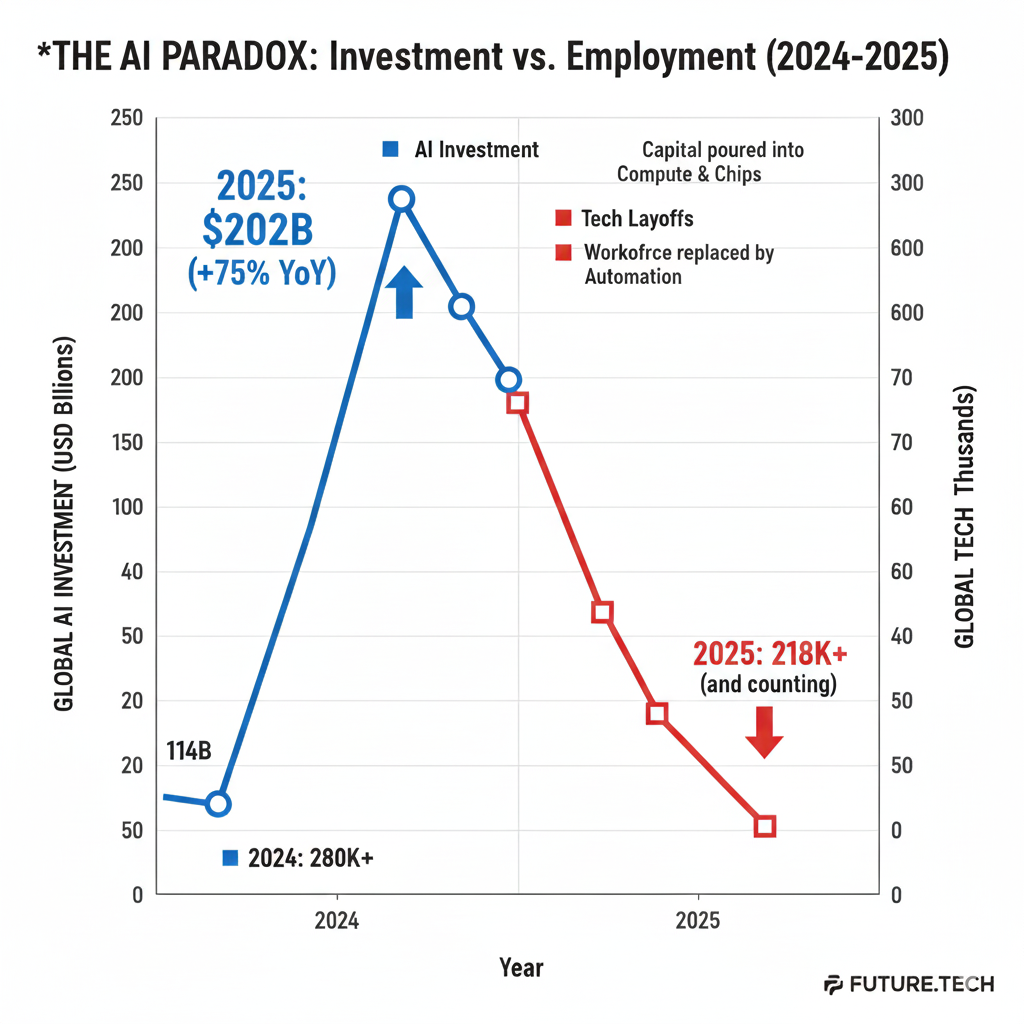
Something doesn’t add up with the 2025 AI layoffs, especially when compared to record AI investment.
In 2025, the tech world is witnessing a historic contradiction. Companies are pouring billions into Artificial Intelligence (AI), yet the headlines are dominated by mass layoffs. From software engineers and data analysts to recruiters and content writers, no sector seems safe.
If the AI economy is booming, why are so many people losing their jobs?
The answer isn’t comfortable, but it is essential for anyone navigating the modern workforce. To understand what’s actually happening, we have to look past the hype. Here is the real reason why the AI surge and job cuts are happening at the exact same time.
What looks like a contradiction is actually a deliberate business strategy
Key Takeaways for 2025:
- The “Scissors Effect”: Investment is spiking while human headcount is dropping.
- Capital Substitution: Payroll budgets are being liquidated to fund AI infrastructure.
- The Skill Pivot: “Doing” is out; “Directing” is in.
2025 AI Layoffs Reality: Why “Growth” No Longer Means “Hiring” (The Efficiency Trap)
The 2025 data reveals a cold reality: AI isn’t just supplementing human work; it’s substituting it. We have entered the era of “Compute-Intensive Growth,” where companies prioritize silicon over salaries.
The 2025 AI layoffs by the Numbers:
- The Investment: Global AI spending hit $202.3 billion (a 75% surge).
- The Cost: Over 218,000 tech professionals were laid off in the same window.
- The Shift: Giants like Google and Meta are diverting $300 billion into AI infrastructure—choosing chips and data centers over human headcount.
From “Supplement” to “Substitute”
For years, we were told AI would be a “co-pilot.” In 2025, it’s becoming the pilot.
- Direct Replacement: Salesforce recently cut 4,000 jobs specifically because AI now handles routine support more efficiently than humans.
- Budget Cannibalization: Payroll budgets are being liquidated to pay for massive Nvidia clusters and LLM API licenses.
- The “Hiring Debt” Myth: These aren’t just “post-pandemic corrections.” This is a systemic recalibration where productivity is finally decoupled from human labor.
The Bottom Line: In 2025, a company can double its output while halving its staff. Understanding this “Compute-over-Labor” shift is the only way to stay relevant in a market that no longer rewards traditional execution.
How to Stay “Un-Replaceable” in the AI Economy (Beyond 2025)
If the 2025 job market has a theme, it is this: Tasks are being automated, but outcomes still require humans. To survive, you must move from being a “Doer” to being a “Director.”
1. Master “Agentic” Literacy
In 2024, the goal was learning to prompt. In 2025, the goal is managing AI Agents. Companies are now hiring “AI Workforce Managers”—people who can oversee a fleet of AI tools performing research, coding, and data analysis. Your value is no longer in doing the research, but in verifying the strategy.
2. Double Down on “High-Stakes” Empathy
Data from 2025 shows that roles in Healthcare, Skilled Trades, and Crisis Management have the lowest automation risk (often under 10%). Why? Because these fields require a “Human-in-the-loop” for legal, ethical, and emotional accountability. If your job involves navigating human conflict or physical unpredictability, you are in the “Safe Zone.”
3. The “Micro-Credential” Pivot
The “half-life” of a technical skill has dropped to just two years. Instead of 4-year degrees, the 2025 market rewards “Stackable Credentials”—short, targeted certifications in AI Ethics, Data Storytelling, or Human-AI Collaboration.
Pro-Tip: Don’t just list “AI” on your resume. List the measurable business value you created using AI (e.g., “Reduced department reporting time by 60% using automated AI workflows”).
FAQs: The AI Paradox Explained
Q: Are layoffs happening because AI is “smarter” than humans?
A: Not necessarily. Many 2025 layoffs are “budget reallocations.” Companies are choosing to spend $1 million on high-end Nvidia chips and AI subscriptions rather than five mid-level salaries. It’s often a financial decision, not a capability one.
Q: Which entry-level roles are most at risk?
A: Roles involving “routine cognitive tasks” are facing a 50% reduction in hiring. This includes junior data analysts, customer support, and basic content writing. The “career ladder” is losing its bottom rungs, forcing graduates to upskill faster than ever before.
Q: Will AI eventually create more jobs than it destroys?
A: History says yes, but 2025 data shows a “lag.” While AI is creating new roles (AI Business Strategists, Ethics Officers), these require high-level expertise. The “job destruction” of clerical work is currently happening faster than the “job creation” of specialized AI roles.
Q: Should I be worried if my company is investing heavily in AI?
A: It’s a double-edged sword. Heavy investment means the company is future-proofing, but it also means they are looking for “efficiency gains.” Your best move is to be the person who implements that AI, rather than the person whose work it replaces.
Final Takeaway ( Read this twice)
The 2025 AI Paradox isn’t an “end” to work—it’s an end to work as we knew it. The “uncomfortable truth” is that the safety net of the 9-to-5 “execution” job is gone. The winners of this era will be those who stop competing with the machine and start leading it.
For more practical insights on AI, automation, and future-ready skills, explore our latest guides on The Automation Strategist.