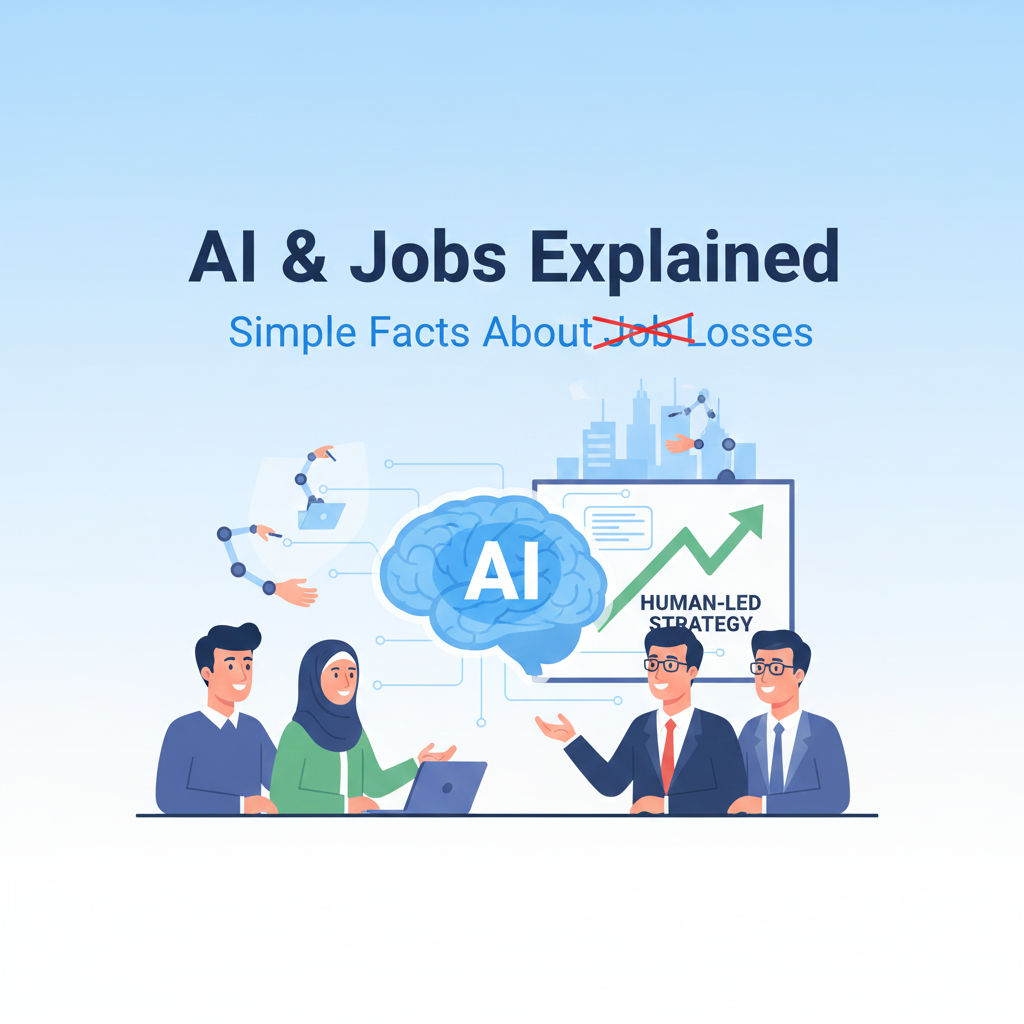
In 2025, one idea refuses to disappear: AI is taking jobs.
Every week, headlines link artificial intelligence to layoffs, hiring freezes, or shrinking teams. It sounds convincing. It’s also incomplete.
From what I’ve seen working with real teams and real workflows, the truth is far less dramatic—and far more useful.
AI and jobs don’t naturally clash. Job losses usually happen when companies make rushed or poorly planned decisions.
AI doesn’t wake up and replace people. Leaders decide how AI is used, where it’s applied, and who is affected. When those decisions are thoughtful, AI supports workers. When they aren’t, people pay the price.
This article explains AI and jobs in simple terms, backed by real data and real examples—so both everyday professionals and business leaders can understand what’s actually happening.
Why AI and Jobs Are Often Blamed Together
Whenever a new technology appears, fear follows. We saw it with machines, computers, and the internet. AI feels more personal because it touches writing, thinking, and decision-making.
But AI does not decide who loses a job—people do.
AI does not:
- Set company budgets
- Choose who gets laid off
- Design organizations
When layoffs happen, blaming AI is easier than admitting leadership or planning mistakes. As a result, discussions about AI and jobs often miss the real cause: how AI is introduced and managed.
The Management Myth Behind “AI Replacing Jobs”
The phrase “AI is replacing jobs” sounds simple, but it hides a deeper issue.
According to the World Economic Forum, AI and automation may displace around 85 million jobs globally, while also creating about 97 million new roles. That’s a net gain—not a collapse.
The real risk isn’t AI—it’s using AI without redesigning how work actually happens.
A McKinsey study shows that while AI can improve productivity by 20–40%, many companies fail to see results due to poor process redesign and weak change management.
This is not a technology failure.
It’s a leadership failure.
The Fake Productivity Trap Explained Simply
Many teams experience the same pattern.
AI tools are introduced to “save time.” Instead, employees end up:
- Managing AI tools
- Fixing AI mistakes
- Doing old tasks and new AI-related work
Productivity looks higher on dashboards, but burnout increases on the ground.
A Gartner report notes that over 70% of AI initiatives fail to deliver expected value, largely because organizations don’t remove old work or train people properly.
How Bad Decisions Actually Lead to Job Losses
When companies lose jobs after adopting AI, it’s usually linked to choices like these:
- Removing junior roles too early
This breaks the talent pipeline. Without juniors today, there are no seniors tomorrow. - Blind trust in AI output
Without human review, errors, bias, and legal risks grow quickly. - Ignoring upskilling
Treating AI as “plug and play” instead of a skill to learn leaves teams behind.
In short: job losses follow bad decisions, not good automation.
Key insight: In 2025, success isn’t about having more AI.
It’s about having a human-centric AI strategy.
How AI and Jobs Can Work Well Together (With a Real Example)
When used carefully, AI supports people instead of replacing them.
The most successful teams use AI to remove busywork—not responsibility.
For example:
Instead of having agents manually sort 500 customer support tickets by category every morning, AI can tag and prioritize them in seconds. This frees the team to focus on solving complex customer issues, not sorting inboxes.
That’s what good AI use looks like.
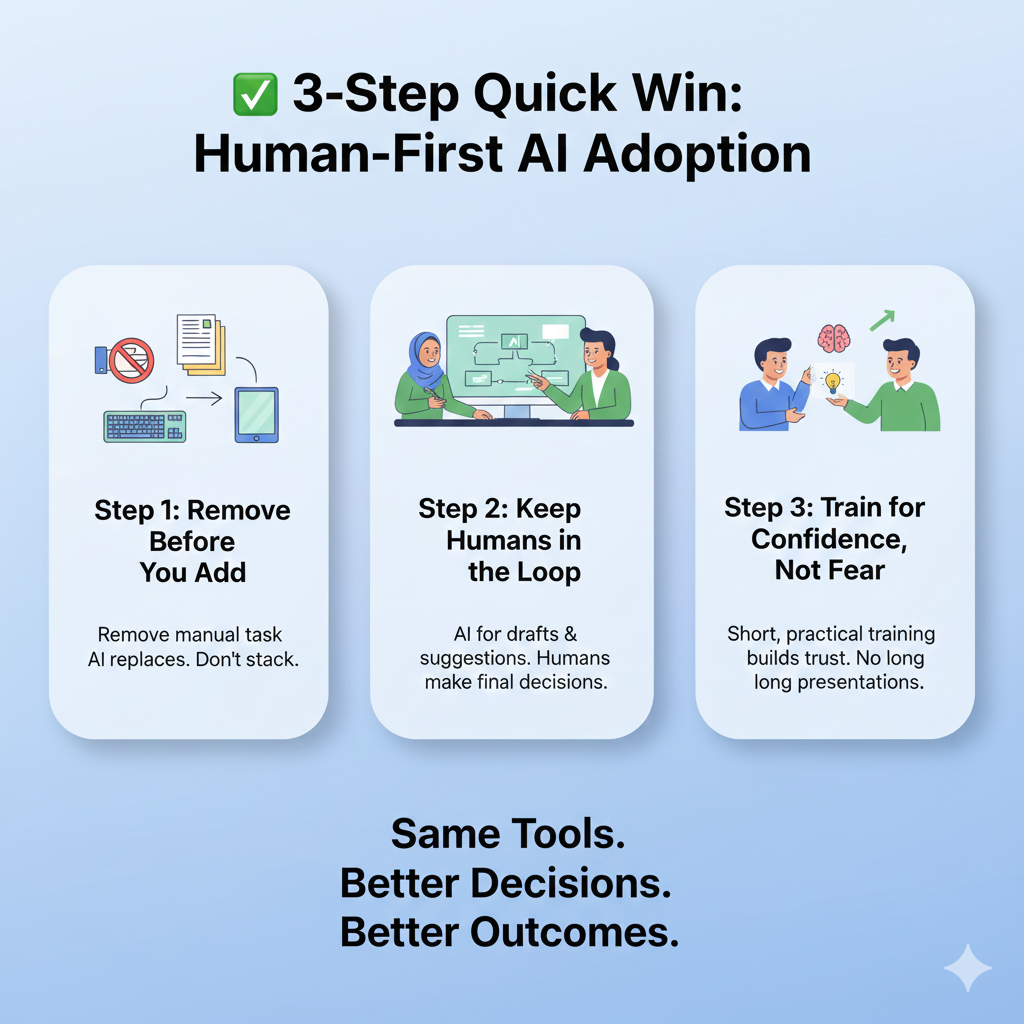
Same tools. Better decisions. Better outcomes.
Related resources:
- Practical AI workflows for everyday business automation
- How AI automation improves productivity without layoffs
What AI and Jobs Mean for Careers in 2025
The goal is not to “beat” AI.
The goal is to direct it well.
Research from MIT Sloan shows that employees who work with AI—reviewing, correcting, and guiding it—see higher performance gains than those who simply automate tasks.
People who stay valuable focus on:
- Reviewing and improving AI output
- Adding context and judgment
- Making final decisions
Soft skills like communication, empathy, and ethics matter more than ever.
What Business Leaders Must Understand About AI and Jobs
For leaders, the choice is clear.
Short-term cost cutting looks efficient—but long-term thinking builds strong companies.
The World Economic Forum repeatedly highlights that re-skilling and human-AI collaboration are the strongest predictors of successful AI adoption—not layoffs.
The future of AI and jobs depends on leadership, not software.
Final Thoughts: Simple Facts About AI and Jobs
AI is not here to replace everyone.
In most real situations:
- AI replaces tasks, not people
- Jobs change instead of disappearing
- Decisions matter more than tools
AI and jobs can grow together—if companies choose wisely.
The biggest risk isn’t AI.
It’s making rushed, short-sighted decisions with it.
❓ FAQs: AI and Jobs Explained Simply
Is AI really replacing jobs?
AI usually replaces tasks, not full roles. Most job losses come from poor planning and leadership decisions, not AI itself.
Why do companies blame AI for layoffs?
Because it’s easier to blame technology than admit strategy or management failures.
Can AI and jobs exist together?
Yes. With training and thoughtful use, AI supports workers and improves productivity.
How should companies adopt AI safely?
Improve workflows first, train employees, and keep humans involved in key decisions.
📩 Want calm, practical insights on AI and work?
Subscribe to our newsletter for clear updates on AI and jobs, without hype or panic.
And if you’re planning AI adoption in your organization, book a consultation to avoid costly mistakes and protect your teams.