
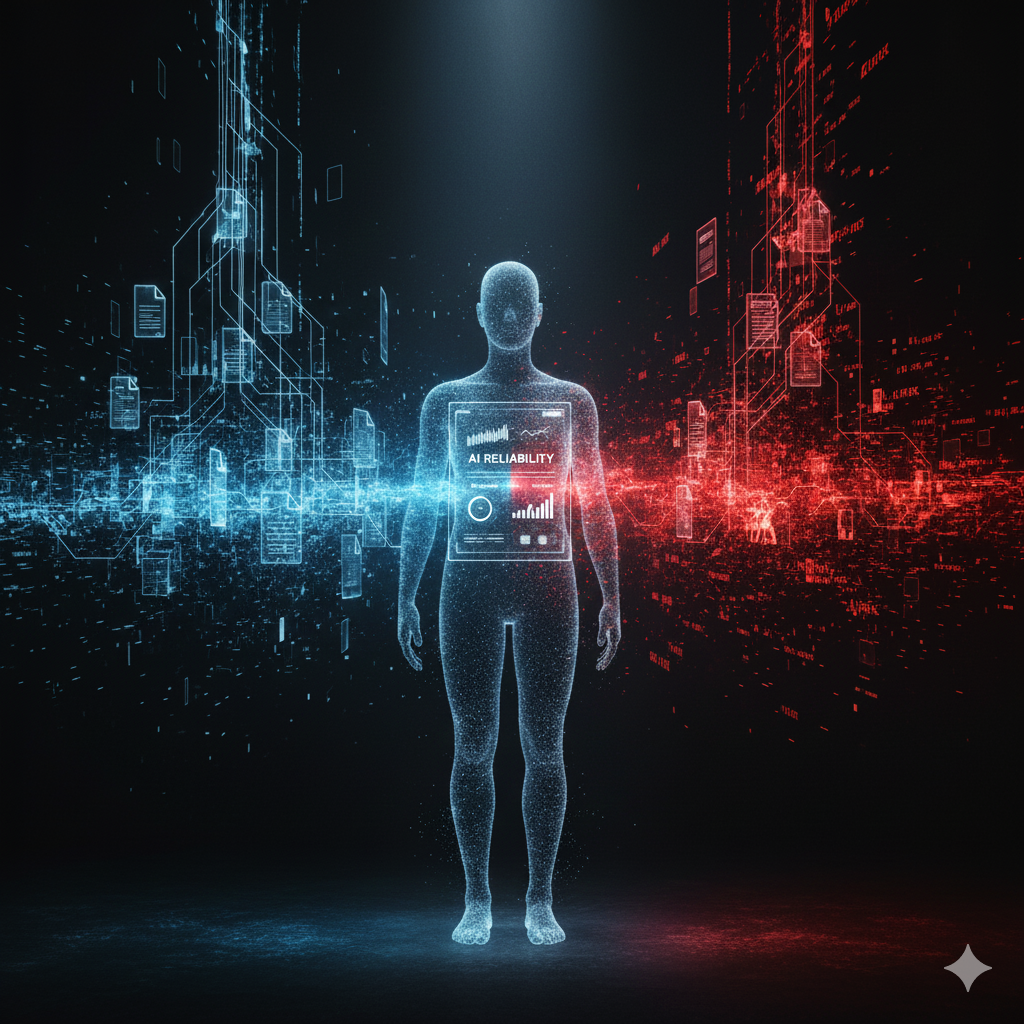
AI Hallucination Protection: Build Trusted Systems in 2026
In my 15 years of leading product and platform teams, I’ve watched countless “next big things” rise and fall. Cloud. Mobile. Big data. Crypto. AI is different, and AI hallucination is the reason. Not because it is smarter—but because it is already making decisions.
In 2026, we’ve moved past the magic phase of chatbots and demos. We are now firmly in the reliability phase. And experience has taught me one hard truth:
If a system isn’t reliable, it’s not a product. It’s a liability.
Today, the biggest invisible wall between your AI product and real user trust is AI hallucination. Not the funny kind. The expensive kind. The kind that quietly breaks workflows, damages credibility, and creates legal exposure.
If you want to scale AI systems in 2026, you need more than accuracy benchmarks.
You need AI hallucination protection by design.
This matters if you’re a product leader, founder, or engineer deploying AI in real systems.
TL;DR — The 2026 AI Clarity Framework
- The Problem: AI hallucinations are no longer edge cases. In agentic AI systems, they become systemic risks.
- The Shield: RAG 2.0 grounds AI outputs in verified, internal data—not model memory.
- The Filter: A “Critic” AI validates outputs before users ever see them.
- The Anchor: Human-on-the-Loop (HOTL) monitors system behavior, not every message.
- The Result: Higher trust, lower liability, and enterprise-ready AI systems built for 2026.
Why AI Hallucination Protection Became a Security Standard?
Ten years ago, product teams worried about uptime, latency, and database leaks.
In 2026, the real risk looks different.
AI hallucinations happen when a model produces information that sounds confident—but is completely wrong. The danger isn’t that the answer is incorrect. The danger is that it sounds right.
Now layer that into agentic AI—systems that can:
- Book travel
- Trigger payments
- Modify code
- Make operational decisions
At that point, a hallucination isn’t a bug.
It’s a broken contract.
In the past six months alone, I have explored real case studies on AI and done POCs on AI systems and I’ve seen hallucinated assumptions.
- Delay supply chains by days
- Corrupt reporting pipelines
- Force product rollbacks just before launch
That’s why AI hallucination protection is no longer an optimization.
It’s a core reliability requirement for production AI systems.
Why This Matters Right Now ?
AI systems in 2026 aren’t assistants anymore.
They are participants.
And when hallucinations scale, so does:
- Financial risk
- Regulatory exposure
- Brand damage
This is exactly why enterprise AI leaders are shifting from “faster models” to trustworthy AI systems.
Step 1: Why RAG 2.0 Became Mandatory for Enterprise AI
The fastest way to stop an AI from lying is simple:
Don’t let it guess.
That’s why modern AI teams are moving away from general-purpose LLM prompts and toward Retrieval-Augmented Generation (RAG 2.0).
Instead of relying on training data or latent memory, RAG forces the model to:
- Retrieve verified internal documents
- Ground every response in those sources
- Cite or constrain outputs accordingly
Think of it like giving a student an open-book exam—but only with your textbook.
In real deployments, this shift alone dramatically reduces hallucinations. However, it only works if your vector database is clean, current, and treated as a true source of truth.
In 2026, we’ve moved beyond “Basic RAG” to Integrated RAG 2.0, where the retriever and the model are optimized as one system. This is essential for meeting EU AI Act Compliance standards regarding data provenance.
RAG 2.0 isn’t about being smarter.
It’s about being anchored.
Step 2: The “Critic” Model — Why Every AI Needs an Editor
After 15 years in product, I’ve learned something simple:
Nothing important goes live without review.
Your AI shouldn’t be an exception.
Modern AI hallucination protection relies on multi-agent architectures:
Agent A: The Doer
Generates responses or executes actions.
Agent B: The Critic
Actively looks for inconsistencies, unsupported claims, or risky assumptions.
If the Critic flags an issue, the system loops—quietly—before the user ever sees the output.
This cross-model probing is one of the least talked-about secrets behind today’s most reliable AI products. It doesn’t slow systems down. It prevents silent failures.
Step 3: Measuring Ai Hallucination Risk with Semantic Entropy
Here’s a trick from 15 years of quality testing:
Ask the same question three times.
If you get three different answers, the system is guessing.
We apply the same logic to AI using semantic entropy.
The system runs the same prompt multiple times and compares the meaning of each output. If the interpretations vary too much, confidence drops.
In 2026, mature AI systems don’t just return answers.
They return confidence scores.
When confidence falls below a threshold, the task is paused or escalated. That’s how you reduce AI hallucinations before they become production incidents.
If you want to dive deeper, researchers at OpenAI are now evolving this into Semantic Energy for even higher precision.
The Shift from Human-in-the-Loop to Human-on-the-Loop
Checking every AI output worked in 2023.
In 2026, it’s impossible.
That’s why leading teams have moved to Human-on-the-Loop (HOTL).
Instead of reviewing every message, humans monitor:
- Drift patterns
- Confidence anomalies
- Escalation frequency
- Edge-case clusters
As a product leader, your job isn’t to read chat logs.
It’s to read the safety dashboard.
HOTL preserves AI speed while keeping human judgment where it matters most—at the system level.
Final Thoughts: In 2026, Trust Is the Only Real Moat
The smartest AI doesn’t win anymore.
The most reliable AI does.
AI hallucination protection isn’t about perfection. It’s about responsibility. When users trust your system, they forgive limitations. When they don’t, no amount of intelligence saves you.
After 15 years of building products, I can say this with confidence:
Trust is the hardest thing to earn—and the easiest thing to lose.
Don’t let a hallucination be the reason you lose it.
FAQs: AI Hallucination Protection
Can AI hallucinations be eliminated completely?
No. AI is probabilistic, not deterministic. However, with RAG, Critic models, and confidence thresholds, hallucinations can be reduced to levels safer than human error.
Is RAG expensive to implement?
It requires data engineering and vector infrastructure. But compared to legal risk, customer churn, and brand damage, it’s one of the cheapest safeguards available.
Does Human-on-the-Loop slow AI systems down?
Not at all. HOTL acts like an emergency brake. The system runs at full speed—until it encounters uncertainty it can’t resolve safely.

Pingback: Assam Earthquake & AI: How Technology Can Predict Disasters?
Pingback: AI Agents Fail Silently: The Hidden Risk No One Monitors
Pingback: Trust Is Broken in AI — RAG 2.0 Fixes it easily