
RAG 2.0: A Product Leader’s Guide to Reliable Intelligence
Building products for over 15 years has taught me one hard lesson: trust is your most expensive asset. It takes years to earn—and seconds to lose.
Early in my career, I watched a legacy support bot confidently tell a high-value client that our premium software was “free for life” due to a data glitch. That single hallucination triggered six months of legal headaches and left a permanent mark on our reputation.
Today, we’re standing at a similar crossroads with AI. Basic models aren’t enough anymore—not because they lack intelligence, but because they guess too often. If you want to scale AI responsibly in 2026, you need RAG 2.0 and trustworthy AI outputs—systems that deliver verified facts, not expensive fictions.
TL;DR: The RAG 2.0 Revolution
- The Shift: We are moving from “finding data” to “reasoning over data.”
- The Problem: RAG 1.0 often loses context, leading to incorrect or “hallucinated” answers.
- The Solution: RAG 2.0 uses GraphRAG and AI agents to verify information before it ever reaches the user.
- The Goal: Total transparency with cited sources and an audit trail for every word generated.
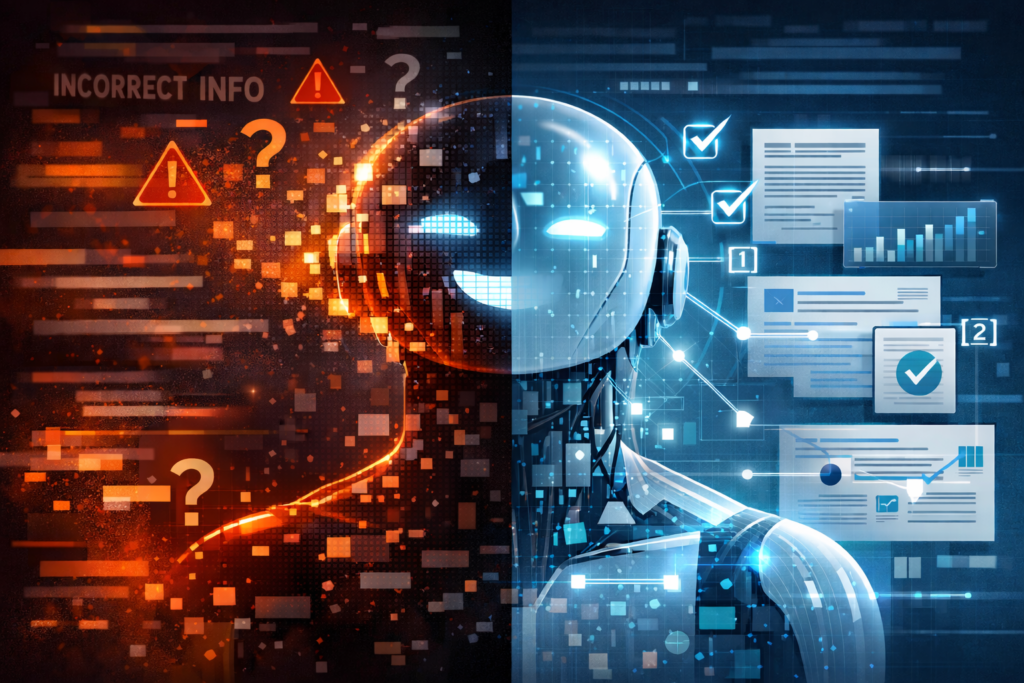
RAG 2.0 & Trustworthy AI Outputs represent an evolved AI architecture that reasons over verified, real-time data and cites its specific sources—or simply refuses to answer if the truth cannot be found.
Why RAG 2.0 & Trustworthy AI Outputs Matter Now
In the early days of AI (think back to 2023-2024), we were just happy that a machine could talk back to us. But the novelty has worn off. In 2026, users don’t want a “chatty” bot; they want an expert.
RAG 1.0 (Retrieval-Augmented Generation) was like a student who skimmed a textbook and tried to answer questions from memory. It worked 70% of the time, but the other 30% was a mess. Consequently, businesses stayed hesitant to put AI in front of customers. RAG 2.0 & Trustworthy AI Outputs change this by creating a “closed-loop” system. It doesn’t just retrieve; it cross-references.
The Evolution of Context
Having managed product lifecycles for over a decade, I’ve seen how “context” is the king of user experience. RAG 2.0 uses something called GraphRAG. Instead of looking at your company documents as a list of words, it sees them as a web of relationships.
For instance, if a customer asks about a warranty, RAG 2.0 knows that the “warranty” is linked to the “purchase date,” the “product model,” and the “regional laws.” It connects these dots automatically. This is how you achieve trustworthy AI outputs that actually make sense in the real world.
The Breakdown: RAG 1.0 vs. RAG 2.0
If you are a Product Manager or a business owner, you need to know what you are paying for. Here is how the two generations stack up when it comes to reliability.
| Feature | RAG 1.0 (The Old Way) | RAG 2.0 (The Trustworthy Way) |
| Citations | Vague or missing | Line-by-line hyperlinks to sources |
| Data Recency | Static/Batched | Real-time live data access |
| Reasoning | Keyword matching | Intent and relationship mapping |
| Hallucinations | Common and confident | Rare; the AI flags uncertainty |
| Accountability | No audit trail | Logged reasoning + source trace |
Real-World Examples for Everyone
You don’t need a computer science degree to appreciate the power of RAG 2.0 & Trustworthy AI Outputs. Here is how it looks for everyday users:
- The Freelancer: You ask an AI to help with your taxes. RAG 1.0 might give you general advice from 2022. RAG 2.0 checks the official IRS 2026 updates and your specific 1099 forms to give you a precise, legal answer.
- The New Parent: You ask if a specific medicine is safe for a toddler. RAG 2.0 doesn’t just “guess” based on blog posts; it pulls the latest data from the FDA’s verified database and cites the dosage chart.
- The HR Manager: You need to check a company policy. Instead of digging through a 100-page PDF, the AI finds the exact sentence in the latest handbook and shows you the “last edited” date.
The Human Side of High-Tech
At the end of the day, RAG 2.0 isn’t just a technical upgrade—it’s a psychological one. In my 15 years in the industry, the most successful products weren’t the ones with the most features; they were the ones people felt they could rely on.
As we move deeper into the AI era, the “wow factor” is gone. What remains is the need for accuracy. Investing in RAG 2.0 & Trustworthy AI Outputs is how you tell your customers, “We respect you enough to get it right.”
Frequently Asked Questions (FAQ)
Is RAG 2.0 only for big corporations?
No. While it requires more thought in the setup phase, tools like Pinecone and LangChain have made these advanced features accessible to startups and small businesses alike.
How does RAG 2.0 stop AI from lying?
It uses a “reasoning loop.” Before the AI answers, a second “evaluator” agent checks the answer against the retrieved documents. If they don’t match, the AI asks for more info or tells the user it can’t find a verified answer.
Will this replace human researchers?
Think of it as a superpower for researchers. It handles the boring “search and find” part, so humans can focus on high-level strategy and emotional intelligence.
What is the first step to implementing RAG 2.0?
The first step is auditing your data. You can’t have trustworthy AI outputs if your internal documents are a mess. Start by cleaning your “knowledge base.”

Pingback: RAG vs Fine-Tuning: How Smart Teams Build Trust in AI