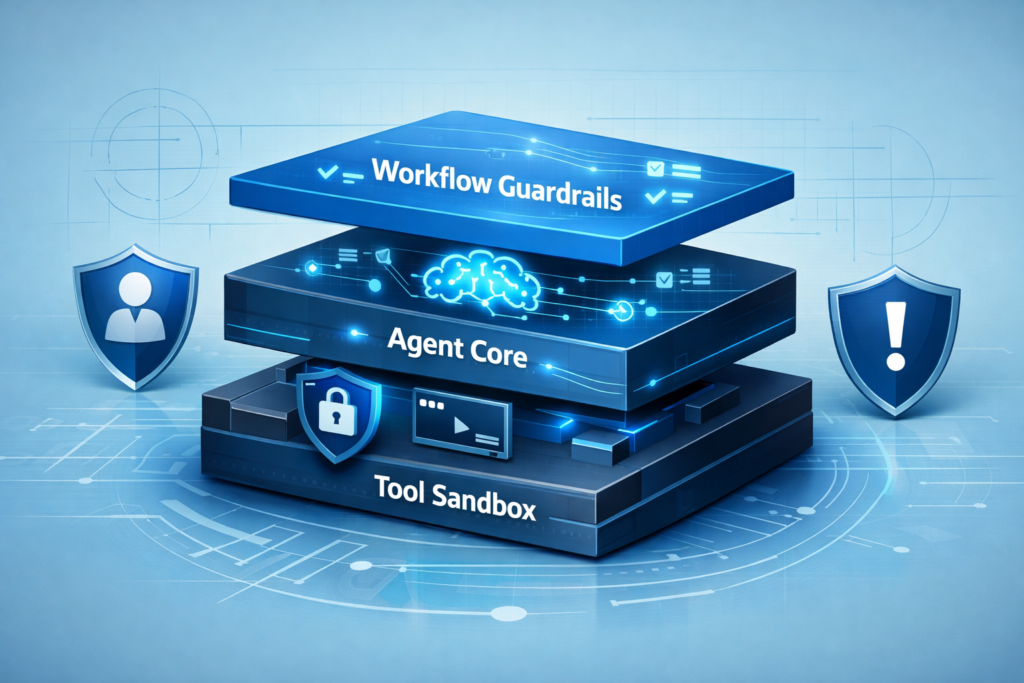
Agentic Systems Blueprint: Safe Workflows + Agents (Without the Chaos)
If you’re building with AI or Agentic Systems in 2026, you’ve probably felt it: the pressure to ship agents—not chatbots, but systems that take actions, call tools, and move real work forward.
After 15 years in product leadership, here’s the uncomfortable truth I keep seeing in production:
Most teams don’t fail because their agent is dumb. They fail because it’s unbounded.
When a powerful model is connected to tools without structure, it won’t “crash” like traditional software. It will fail politely—by hallucinating a policy, taking a risky action, or looping on a tool error until the bill shows up.
If your agent can “decide the next step,” your code must decide the boundaries.
Understanding the Agentic Systems: Workflows vs. Agents
Workflows = rails.
Agents = engine.
Agentic systems = both.
Before building, we must define our terms. Many people use “agent” and “workflow” as the same thing, but they are very different. According to Anthropic’s architecture distinction, workflows are systems where the path is predefined by code. In contrast, agents are systems where the AI itself decides which steps to take to reach a goal.
In a modern agentic systems setup, you don’t choose one or the other. You blend them. You use workflows for the parts of the job that must be 100% predictable. Then, you let the agent handle the “fuzzy” logic where flexibility is needed.
The Agentic Systems Blueprint (One-Screen View)
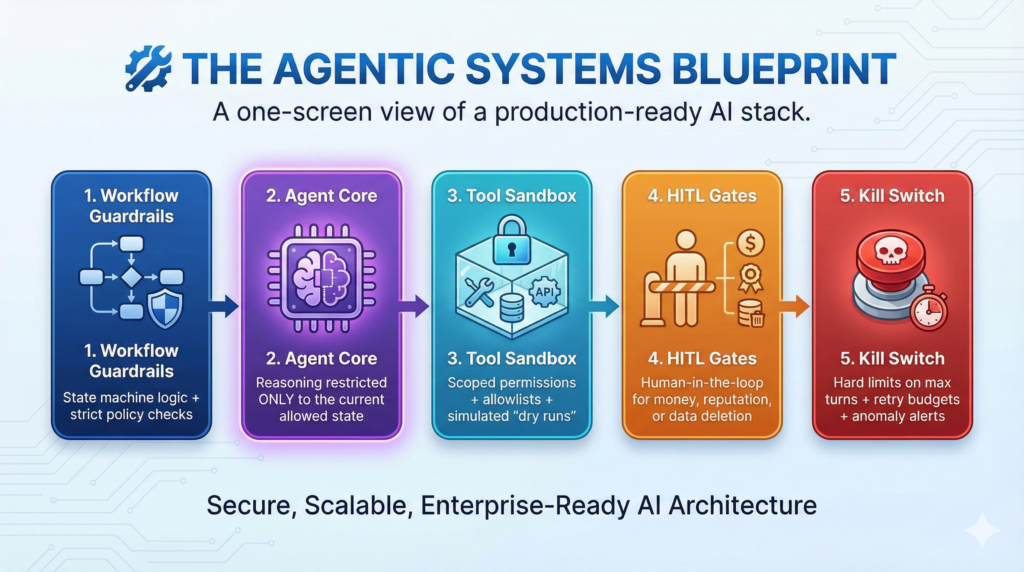
- Layer 1 — Workflow Guardrails: states + policy checks + allowed transitions
- Layer 2 — Agent Core: reasoning only inside allowed states
- Layer 3 — Tool Sandbox: least privilege + allowlists + audit logs + MCP tooling
Non-negotiables:
- Human-in-the-Loop (HITL) for high-risk actions
- Kill switch stop conditions for loops, retries, and token spikes
TL;DR
- Don’t ship free-roaming agents. Ship bounded agents.
- Pure agents are too unpredictable; pure workflows are too rigid.
- The fix is agentic systems: flexible reasoning inside deterministic rails.
- Add HITL for money, reputation, and sensitive data.
- Add a kill switch so your agent knows when to stop.
“Agents don’t crash when they fail. They keep going—confidently—until the bill shows up.”
The 3-Layer Agentic Systems Blueprint
Layer 1: Workflow Guardrails (The Rails That Prevent Chaos)
This is the unsexy layer that saves you.
Define states and enforce allowed transitions with preconditions:
- No Execute before Verify Identity
- Refunds require policy match (+ HITL above a threshold)
- Sensitive changes require confirmation
Guardrails shrink the agent’s choice space and stop “agent slop” (skipped steps, invented policy) before it reaches production tools.
“Workflows don’t limit intelligence. They limit blast radius.”
Layer 2: The Agent Core (Reasoning Engine Inside Boundaries)
Now let the model do what it’s good at: understanding intent, resolving ambiguity, and choosing an action—but only after guardrails narrow the options.
A production-safe pattern:
- Provide the agent: current state + allowed actions + grounded context
- Agent outputs: next action + structured arguments + confidence score
- Code validates: schema + policy + risk category
- Tools execute only after validation
This reduces hallucinations, random tool usage, and token waste.
Layer 3: Tool Sandbox (Execution Safety + MCP)
Most “agent disasters” happen at execution time, not reasoning time. That’s why your tools must be locked down:
- least-privilege credentials
- allowlisted endpoints + parameter constraints
- read-only by default
- replayable audit logs
To stay bleeding-edge in 2026, expose tools through the Model Context Protocol (MCP).
MCP is becoming the standard way agents talk to tools via structured schemas and tool servers. Practically, it helps you:
- standardize tool interfaces
- validate tool arguments before execution
- control what data tools return
- enforce allowlists and permissions consistently
In other words: MCP makes your sandbox easier to govern—especially as your tool ecosystem grows.
“The model can suggest actions. Only the sandbox can authorize them.”
Human-in-the-Loop (HITL): The Checkpoint That Saves You
I’ve shipped enough systems to know “set it and forget it” is how invisible disasters happen.
Use HITL for:
- transactions above a threshold
- external communications to key clients
- deleting/modifying sensitive user data
Rule of thumb: if it can cost money, harm reputation, or change truth—add HITL.
Kill Switch: Stop Conditions You Need on Day One
Agents “try harder” when stuck. In production, that often means looping longer.
Add these stop conditions immediately:
- Max turn limit (e.g., stop after 8 steps)
- Retry budget per tool (e.g., 3 failures → escalate)
- Confidence threshold (low confidence → ask for info or route to human)
- Anomaly alerts (token spikes, repeated actions, unusual tool frequency)
Production Checklist (Copy/Paste)
Before your agent touches real systems:
- Tool allowlist defined
- Least-privilege permissions set
- Read-only mode tested end-to-end
- HITL thresholds configured
- Max turns + retry budgets enforced
- Audit logs + rollback path in place
- MCP tool schemas documented and validated
Final Thoughts:
Reliability Wins in 2026
The goal isn’t the “smartest” agent. It’s the most reliable system.
Combine workflow predictability with agent reasoning, and enforce execution through a sandbox—ideally standardized with MCP. That’s how you ship agentic systems that scale safely without burning budget or trust.
FreQuently Asked QUestions
1. Does the Model Context Protocol (MCP) replace the need for a Tool Sandbox?
No, they are complementary. MCP provides the standardized interface for how an agent discovers and calls a tool, but the Sandbox provides the execution environment. Think of MCP as the “contract” (what the agent can ask for) and the Sandbox as the “containment cell” (limiting what the tool can actually do to youserver if the agent sends a malicious command). You need both to be truly secure in 2026.
2. What is the real “looping cost” difference between a pure agent and this blueprint?
In my experience, a pure, unconstrained agent can easily burn 5x–10x more tokens than an agentic system. Because a pure agent has to “re-reason” its entire plan every turn, it accumulates massive context overhead. By using Workflow Guardrails, you offload the logic to cheap, deterministic code, reserving the expensive “Agent Brain” only for the high-value decision points. In a production run of 1,000 tasks, the savings can be the difference between a profitable feature and a net loss.