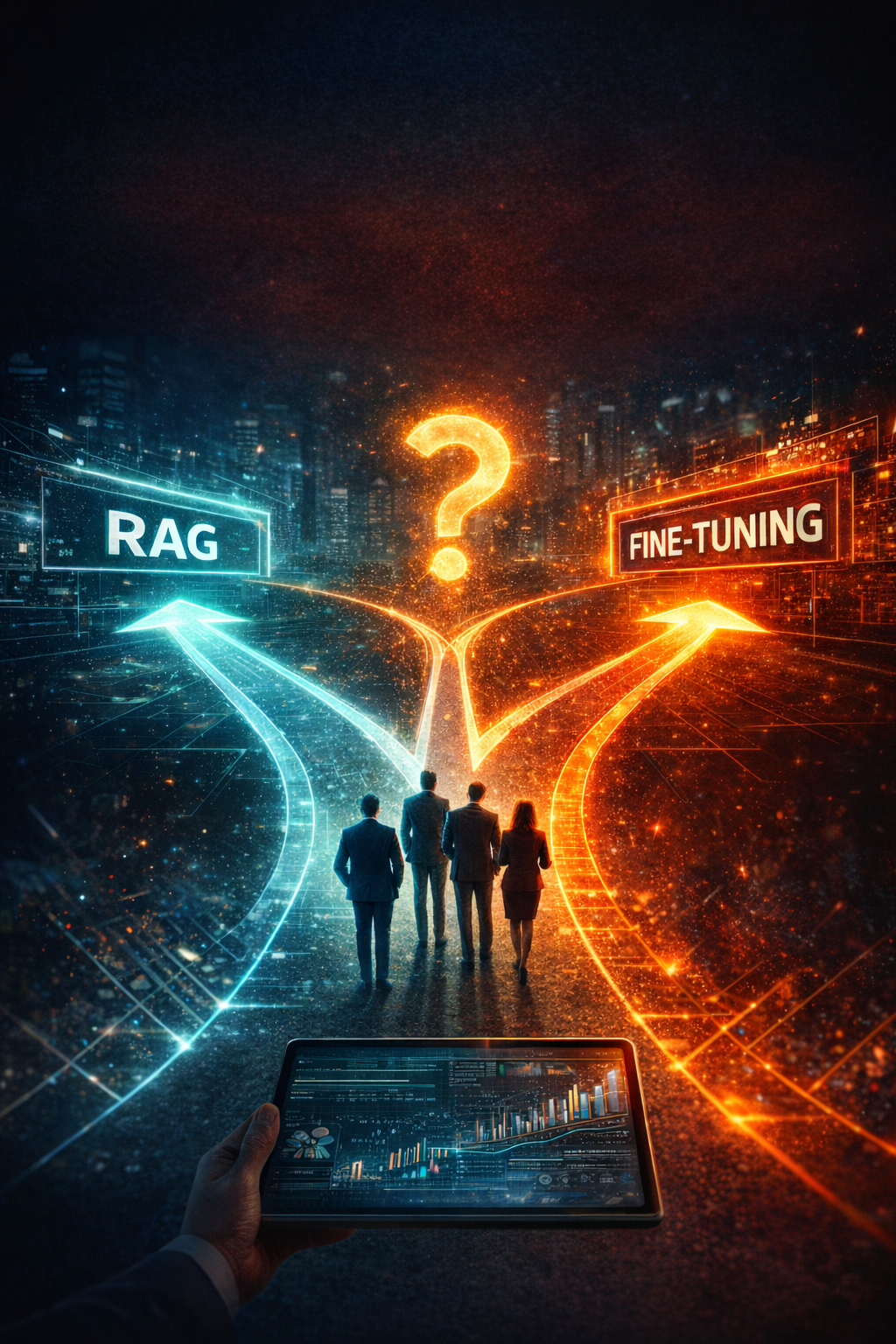
If you are a manager, director, or product leader, here is a hard truth most AI decks will never tell you:
Most AI projects do not fail because the model is weak.
They fail because leaders choose the wrong way to add “expertise.”
After spending the last 15 years in Product Management, I’ve seen technology cycles rise and fade—cloud, mobile, big data, crypto. But what’s happening in 2026 is different.
AI is no longer a flashy demo in a boardroom.
It now:
- Answers customer tickets
- Reviews legal documents
- Flags risks in financial data
- Influences real business decisions
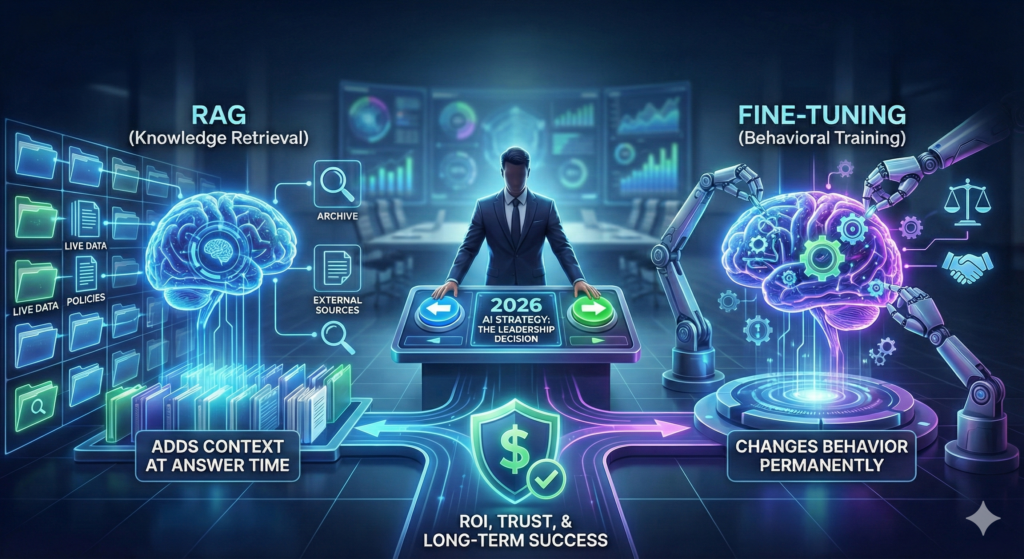
And that’s exactly why the RAG vs Fine-Tuning decision quietly determines your ROI, trust, and long-term success.
Summary
- RAG adds knowledge at answer time using your live documents
- Fine-Tuning changes behavior at training time
- Best teams in 2026 use RAG for truth and Fine-Tuning for trust
If you get this wrong, you end up with a system that is either:
- Confidently wrong
- Or prohibitively expensive
Let’s break this down in plain English.
RAG vs Fine-Tuning in 2026: Where Does “Truth” Actually Live?
In 2026, the real question isn’t which model is smarter.
It’s this:
Where does your AI get its truth from?
What Is RAG? (Think: The Librarian)
RAG stands for Retrieval-Augmented Generation.
Imagine your AI as a brilliant assistant sitting next to a massive filing cabinet.
When you ask a question, the assistant:
- Searches the cabinet
- Pulls the most relevant folders
- Reads them
- Answers based only on those documents
The model itself does not change. Only the context does.
That’s why RAG is called an inference-time technique.
Real Business Example: Policy & Compliance
You ask:
“What is our latest travel reimbursement policy?”
- Without RAG → The AI guesses based on generic policies
- With RAG → The AI reads your actual HR document and answers correctly
Why leaders prefer RAG:
- No retraining required
- Updates instantly when documents change
- Lower upfront cost
- Easier to audit and explain
RAG = AI with access to your files
What Is Fine-Tuning? (Think: The Specialist)
Fine-Tuning is different.
It is a training-time technique.
You show the AI thousands of examples of:
- How to respond
- What tone to use
- Which logic paths to follow
You are literally reshaping its internal behavior.
This is not about looking things up.
This is about building habits.
Real Business Example: Brand & Judgment
Imagine an AI that:
- Must sound empathetic
- Must avoid legal promises
- Must escalate sensitive cases
Fine-Tuning ensures:
- Every response follows your brand rules
- Even without long prompts
- Even at massive scale
Fine-Tuning = AI trained to behave like your best employee
The Hidden Costs That Kill AI Projects
After 15 years in product, I’ve learned this:
Projects rarely fail loudly.
They fail quietly—through hidden costs and lost trust.
Risks of RAG
- Messy data = messy answers
- Retrieval errors can surface the wrong document
- Requires strong data hygiene
Risks of Fine-Tuning
- Knowledge becomes static the moment training ends
- Expensive to redo
- Harder to adapt quickly
- Risky if assumptions change
This is why many 2024–2025 AI pilots stalled in 2026.
RAG vs Fine-Tuning: Executive Decision Matrix
| Business Need | Best Choice | Why |
|---|---|---|
| Frequently changing data | RAG | No retraining required |
| Brand voice & tone | Fine-Tuning | Consistent behavior |
| Citing exact sources | RAG | Verifiable answers |
| Low latency responses | Fine-Tuning | No document lookup |
| Security & compliance | RAG | Data stays internal |
Product Leader Tip (2026 Reality)
The smartest teams fine-tune Small Language Models (SLMs) and pair them with RAG.
Why?
- 10–20× lower inference costs
- Faster responses
- Easier governance
This is how teams make small models behave like giants—without giant bills.
The 2026 Gold Standard: RAG-First, Fine-Tuning Second
This is not an either/or choice.
The best systems today follow a hybrid strategy:
- Fine-Tune the model to understand your industry and behave correctly
- Use RAG to feed it real-time, authoritative data
This creates AI that is:
- Accurate
- Consistent
- Explainable
- Trustworthy
In regulated industries—finance, healthcare, legal—this is already the default.
Frequently Asked Questions (FAQ)
Final Thought
As a leader, your real job is not adopting AI.
It is building trust.
In 2026:
- Trust comes from accuracy
- Accuracy comes from architecture
- Start with RAG to get the facts right.
- Then use Fine-Tuning to make the experience feel right.
That quiet decision is what separates AI experiments from AI systems that actually scale.