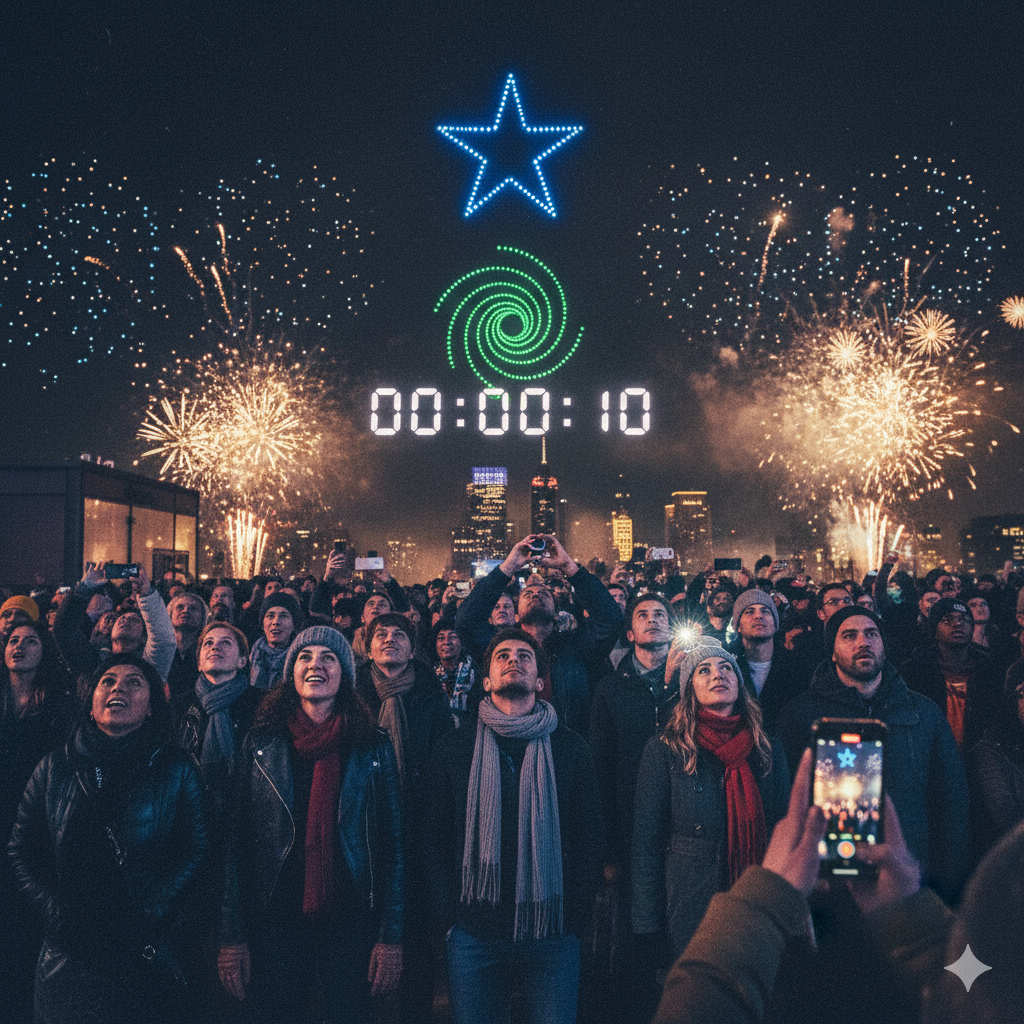
Beyond Fireworks: 5 Ways AI Is Quietly Transforming Your New Year’s Eve in 2026
Every New Year’s Eve carries a familiar rhythm. The countdown. The noise. The promise that next year will be different.
Yet as we move toward 2026, that difference won’t come from bigger fireworks or louder parties. It’s arriving more quietly—through artificial intelligence, working behind the scenes to make New Year’s Eve smoother, safer, and more meaningful.
Not in a sci-fi way.
In a human way.
Here’s how AI is reshaping New Year’s Eve 2026, often without you even noticing.
TL;DR — What’s Changing on New Year’s Eve
- AI-powered drone and AR fireworks will replace noisy displays
- AI agents will plan personalized New Year’s Eve parties
- Smart crowd prediction will improve safety at public events
- Music and entertainment will adapt to real-time energy
- AI assistants will help you recover and plan the year ahead
1. The Digital Sky: Fireworks Without the Noise
Fireworks are iconic—but they come at a cost. Noise pollution, safety risks, and environmental impact have become hard to ignore, especially on New Year’s Eve, when cities host massive crowds.
Some cities have already begun experimenting with AI-coordinated drone light shows, where thousands of drones create synchronized, silent visuals in the sky. If you’ve seen recent celebrations in places like Dubai, you’ve already glimpsed this future.
What’s coming next is even more personal—and immersive. By 2026, Augmented Reality layers may allow people to see customized fireworks through their phones or smart glasses—designed just for them.
This isn’t just a concept; the 2025 releases of AR glasses from major tech giants (like Meta’s Orion prototypes and the latest Google/Samsung XR collaborations) are turning these lenses into the primary way we consume digital entertainment in the real world.
This isn’t about replacing tradition.
It’s about evolving it.
Why it matters:
Your New Year’s Eve becomes breathtaking without harming the environment or overwhelming the senses.
If you’ve watched Dubai experiment with drone-powered celebrations or followed how augmented reality is evolving at companies like IBM, this shift may already feel familiar.
2. Your Personal Party Architect: AI Plans the Night for You
Planning a New Year’s Eve party sounds fun—until it isn’t.
Guest preferences clash. Dietary needs are forgotten. Playlists fall flat. This is where AI quietly steps in.
Advanced AI assistants—building on tools many people already use for daily planning—will soon act like personal event architects. They’ll suggest menus based on guest preferences, curate music that fits the crowd, manage RSVPs, and even remind you when it’s time to slow the night down.
If you’ve ever wondered how AI is already helping non-technical people save time in daily life, this is a natural extension of that shift.
Suddenly, you’re not managing the party.
You’re present in it.
Why it matters:
Less stress. More presence. You actually enjoy your own New Year’s Eve.
3. The Unseen Guard: AI and Crowd Safety on New Year’s Eve
Anyone who’s attended a large New Year’s Eve event knows the stress—long lines, packed streets, uncertainty.
What most people don’t see is how AI is already being used by cities to predict crowd movement. By analyzing transit data, weather patterns, and historical event behavior, these systems help organizers anticipate congestion before it happens.
As global conversations around smart cities and AI-driven public safety continue to grow, New Year’s Eve becomes one of the clearest examples of AI working quietly in the background—guiding traffic, suggesting safer routes, and reducing risk without disrupting the celebration.
You won’t feel controlled.
You’ll just feel less overwhelmed.
Why it matters:
A safer, calmer New Year’s Eve with fewer frustrations.
4. Beyond the Playlist: Music That Reads the Room
Music defines the energy of New Year’s Eve. Yet static playlists often miss the moment—too slow, too loud, or completely off-vibe.
Streaming platforms already use AI to recommend songs. The next step is real-time adaptation.
By 2026, AI-powered sound systems may adjust tempo, genre, and volume based on movement, conversation levels, and overall energy. Some systems may even introduce short interactive moments—games, trivia, or countdown rituals—without interrupting the flow.
If you’ve been following how AI is shaping everyday entertainment experiences, this evolution feels less futuristic and more inevitable.
The result?
No awkward lulls. No forced hype. Just a night that flows.
Why it matters:
Your New Year’s Eve flows naturally—no awkward silence, no vibe crashes.
5. The Morning-After Assistant: January 1, Reimagined
New Year’s Eve doesn’t end at midnight. It ends the next morning—often with fatigue, regret, or forgotten resolutions.
AI is changing that too.
Wellness apps already experiment with personalized routines. By 2026, AI assistants may suggest hydration schedules, gentle movement, and calming routines tailored to your night. More importantly, they’ll help translate New Year’s resolutions into realistic, step-by-step plans.
This aligns closely with what behavioral science has shown for years: goals succeed when they’re structured, not emotional.
Instead of “This year will be different,”
you’ll know how it will be.
Why it matters:
You don’t just celebrate the new year—you begin it with intention.
Try These AI Prompts This New Year’s Eve
Want to experience this shift right now? Try these simple prompts:
- Reflection:
“Summarize my past year into lessons worth carrying forward.” - Planning:
“Turn my New Year’s goals into a practical 90-day plan.” - Celebration:
“Help me design a calm, meaningful New Year’s Eve schedule.”
Sometimes, the most powerful use of AI is simply asking better questions.
FAQ: New Year’s Eve and AI
Ringing in a Smarter New Year
The future of New Year’s Eve isn’t louder fireworks or bigger crowds.
It’s less stress, more presence, and better beginnings.
AI won’t take the magic away.
It will quietly protect it.
As 2026 approaches, the real question isn’t whether AI will be part of your New Year’s Eve—but how intentionally you’ll let it shape the year ahead.
👉 What part of this future New Year’s Eve feels most exciting—or unexpected—to you?