
The Death of the Dead Pixel: How AI Is Replacing Dashboards (And Why Your Data Is Lying to You)
Most dashboards don’t fail because of bad data.
They fail because no one wants to look at them anymore.
After 15 years working across product, data, and enterprise systems, I’ve seen the same pattern repeat itself in company after company. A problem emerges. A dashboard is built. For a short period, everyone pays attention.
Then reality sets in.
Usage drops.
Logins fade.
The dashboard becomes background noise.
Think about it this way: people don’t want charts — they want answers. And that single truth explains why AI is replacing dashboards in modern companies faster than most leadership teams realize.
We’re moving away from looking at data and toward talking to data.
TL;DR
- Dashboards aren’t failing because of bad data — humans are overloaded
- Industry research consistently shows only ~20% of business users actively engage with dashboards, despite widespread deployment
- AI replaces dashboards by delivering decisions, not charts
- Agentic BI and LLM-driven data layers turn analytics into natural conversations
- Modern companies stop “checking dashboards” and start acting on AI alerts
Bottom line:
If your team still logs in to “look for insights,” your data isn’t helping you — it’s slowing you down.
Why Classic Dashboards Fail in the Age of AI
AI can monitor data continuously — and that’s exactly why classic dashboards are losing human attention.
For years, dashboards were positioned as the “single source of truth.”
But here’s the kicker — truth is useless if it’s buried.
Traditional dashboards are passive by design. They wait patiently for humans to:
- Log in
- Apply filters
- Interpret trends
- Guess root causes
- Decide what to do next
Meanwhile, the business keeps moving.
According to multiple industry surveys summarized by BI analysts and research firms, only around 20% of business users actively engage with the dashboards made available to them, even though dashboards are widely deployed across enterprises. This gap between availability and usage is often described by practitioners as dashboard fatigue — a condition where screens exist, but attention doesn’t.
This pattern has been echoed repeatedly in enterprise analytics research, including insights cited by Gartner and independent BI communities, which note that static dashboards struggle to sustain engagement beyond initial rollout.
This isn’t a tooling failure.
It’s an attention failure.
A dashboard doesn’t eliminate work.
It quietly assigns it.
In 2026, when attention is the most limited resource inside any organization, that model simply doesn’t scale.
What “AI Replacing Dashboards” Actually Means
Let’s define this clearly — because this phrase is often misunderstood.
AI replacing dashboards doesn’t mean fewer charts. It means fewer humans translating charts into decisions.
AI-driven analytics replaces dashboards by shifting insight delivery from screens to decisions. Instead of humans hunting for meaning, LLM-driven data layers and Agentic BI systems continuously interpret data, detect anomalies, and recommend actions in natural language.
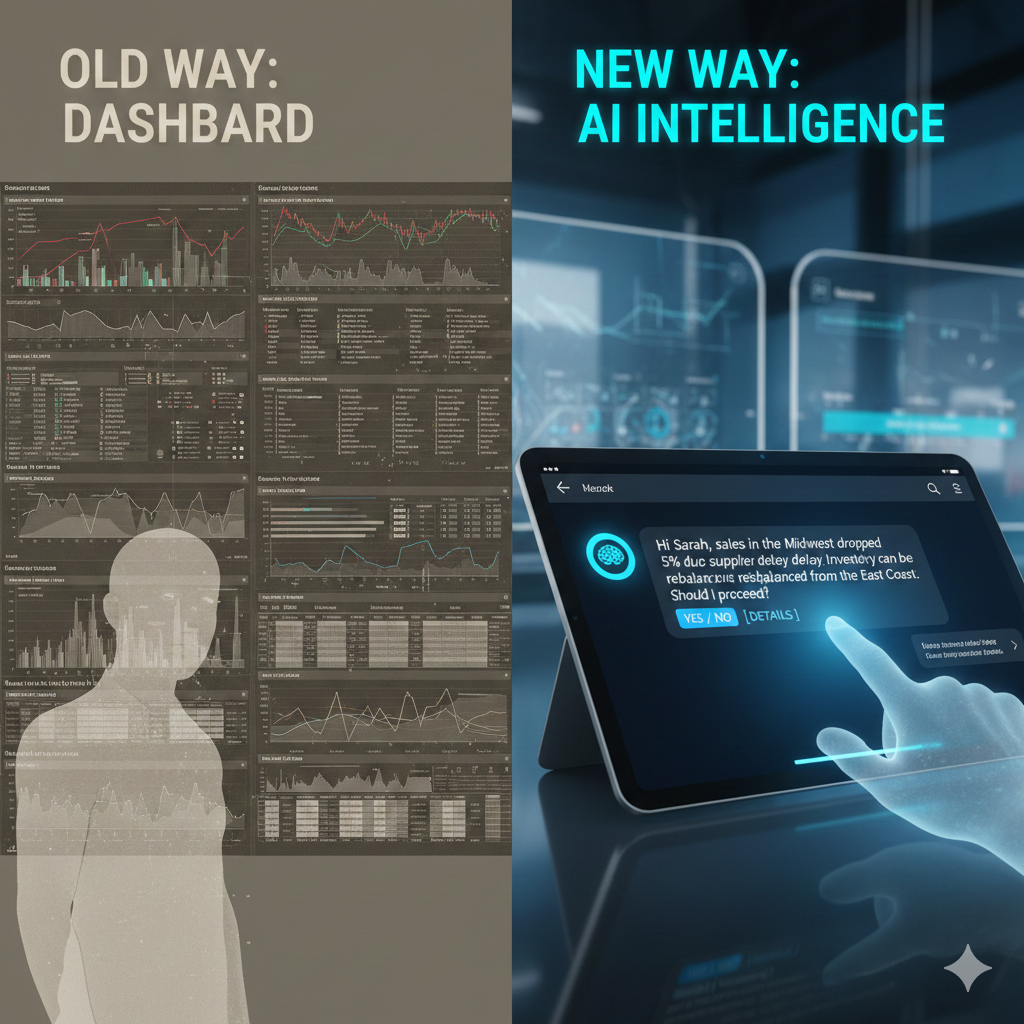
This architectural shift closely mirrors what modern analytics platforms and data transformation leaders — including dbt Labs — describe as the move toward a governed semantic layer that machines can reason over, not just visualize.
In short: the insight comes to you.
That’s where the real magic happens.
1. From “What Happened?” to “What Should We Do Next?”
Traditional dashboards are backward-looking.
They explain yesterday.
AI systems are forward-looking.
Instead of logging into a BI tool and noticing a red bar, an AI agent can proactively message your Slack or Microsoft Teams channel and say:
“Sales in the Midwest dropped 5% due to a supplier delay. Inventory can be rebalanced from the East Coast. Should I proceed?”
This shift — from passive reporting to proactive recommendation — aligns with how Gartner describes the evolution from descriptive analytics to decision intelligence.
The analysis step disappears.
The decision arrives pre-contextualized.
2. Natural Language Is the New Analytics Interface
You shouldn’t need SQL, LookML, or dashboard training to understand your own business.
That’s why Agentic BI and LLM-driven semantic layers are rapidly becoming the default analytics interface. Instead of dashboards, teams interact through conversation:
- “Which customers are most likely to churn this month?”
- “Why did support tickets spike yesterday?”
- “What’s the fastest way to improve retention this quarter?”
This conversational shift reflects a broader industry movement toward natural language analytics, a trend repeatedly highlighted in enterprise AI research and product roadmaps across the analytics ecosystem.
You ask.
The system reasons.
You get an answer.
No dragging filters.
No rebuilding charts.
No waiting on analysts.
For the first time, analytics works the way humans actually think.
3. Personalization Beats One-Size-Fits-All Dashboards
Dashboards assume everyone needs the same view of reality.
They don’t.
A CEO, a product manager, and a customer success lead care about entirely different signals. AI systems learn those preferences over time and generate personalized intelligence streams, not static screens.
This concept of role-based intelligence delivery is increasingly discussed in modern BI research as a key limitation of traditional dashboards.
Instead of one shared dashboard, each role receives:
- Context-aware alerts
- Role-specific insights
- Clear recommendations
It’s like having a personal analyst embedded directly into your workflow — one who understands what actually matters to your decisions.
The Strategic Advantage of Going Dashboard-Light
Now, here’s where strategy enters the picture.
When companies stop forcing teams to “check dashboards,” attention shifts back to execution. In my experience, the organizations that win are the ones that reduce friction to insight.
If finding a KPI takes three clicks, you’ve already lost momentum.
AI reduces those clicks to zero by pushing insights directly into:
- Slack or Microsoft Teams
- CRMs
- Operational tools
This aligns with Gartner’s repeated emphasis on “embedded analytics” and “decision-centric workflows” as core drivers of business value from data.
Insight goes where work already happens — not the other way around.
Transitioning to an AI-First Data Culture
Of course, dashboards won’t disappear overnight — and they shouldn’t. They still matter for audits, deep dives, and exploratory analysis.
But daily operations are changing — quickly.
After navigating multiple product and data platform cycles, my advice to leaders is simple:
Stop building screens. Start building streams.
Stream your data into an AI-ready semantic layer — the same architectural direction advocated by dbt Labs and modern analytics engineers — so intelligence can be reasoned, not rendered. Trust the system to monitor continuously and surface what matters.
Humans shouldn’t babysit charts while data changes in real time.
Final Thoughts
Why AI is replacing dashboards in modern companies isn’t just a technology shift — it’s a human one. We’re finally letting machines do the math so humans can focus on judgment, creativity, and strategy.
If your company is still staring at static charts, you’re not just behind.
You’re leaking time, focus, and money.
It’s time to automate your insights.
FAQs
Will dashboards disappear completely?
No. Dashboards will still exist for audits, deep analysis, and regulatory needs. But for daily decision-making, AI-driven alerts and conversations will dominate — a direction consistently outlined in enterprise analytics research.
Is AI analytics more accurate than dashboards?
The data source is the same, but AI dramatically reduces human interpretation errors and surfaces patterns that static charts often hide, a benefit frequently cited in AI-driven analytics studies.
How do I start replacing dashboards with AI?
Start by connecting your data warehouse to an LLM-driven analytics or Agentic BI layer. Shift from “check-in” management to alert-based operations, following the same transition patterns recommended by modern data platform leaders.
Want to go deeper?
If this resonates, I share practical, real-world AI insights like this regularly.
- Start with our practical guide to implementing AI in real teams
- See how modern data stacks think about the semantic layer (dbt Labs)
- And if you want the big-picture view, Gartner’s research on AI analytics is a solid reference
- If you are a techie and need a big picture view on how AI is helping with code vulnerability
No hype. Just what’s actually changing — and what to do about it.